
ONE MONTANA VOICE Column by Mary Sheehy Moe
Published in the Helena IR on March 19, 2026
Curating my mother’s memorabilia recently, I stumbled on this sketch my older sister drew of a younger one. It’s a wonderful portrait … ruined, the casual observer would conclude, by my mother’s frenzied jottings all over the page.
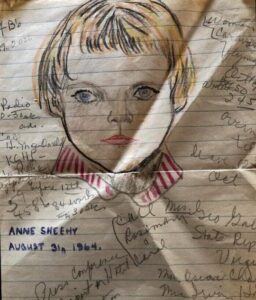
But to me those jottings betray an almost palpable excitement. In the 1960s, Mom caught the activist bug. She was constantly calling talk shows, contacting legislators, organizing, attending press events.
She was not alone. By the late 1960s, Montana women were locking arms to advance change. Organizations like Montana’s Business and Professional Women (BPW), the American Association of University Women (AAUW), and the League of Women Voters were pursuing a variety of causes. The cause at the top of all their lists was a new constitution for Montana.
Much has been written about the 1972 constitutional convention — “the Con-Con” — and the remarkable document it produced. But an important sub-plot of that story is the role women played in achieving that milestone. Given that this Friday’s first-ever observance of Montana Constitution Day occurs in the middle of Women’s History Month, it seems timely to reflect on that.
Among the 100 delegates elected to the Con-Con, 19 were women. They sat in a chamber where at most two women had sat together before. The majority listed “housewife” as an occupation, but like my mother, they’d been active in advocacy for years. They’d studied our Constitution longer than most of their male counterparts. And because current legislators couldn’t serve in the Con-Con, there was no pre-existing male culture for these 19 women to “learn.” Everyone was a “freshman.”
Sure, at first there was an exaggerated deference, with male delegates addressing female delegates as “madam delegate.” But Betty Babcock, the ever-circumspect wife of the former governor, rose to put an end to that. Noting that the delegates had eliminated partisanship by sitting alphabetically, she declared, “I think we should get rid of sex on the floor.” President Leo Graybill stepped in, as he always did, to rescue her from mortification. “I think that’s probably a good idea,” he responded, straight-faced. No more madams, Adam.
Louise Cross of Glendive had her hands full chairing the Natural Resources and Agriculture Committee. Her committee members, all male, resisted the environmental protections she advanced — with arguments that ranged from nit-picky to condescending to downright silly. But the delegates at large saw the logic of her stances — and the homework she’d done to reach them — and found ways to realize her intent.
My favorite example is the provision requiring that Montanans maintain a “clean and healthful” environment for future generations. Cross’s committee, over her strong objection, wanted the adjectives struck from the provision. “Clean” and “healthful” are too ill-defined, they said. After hours of debate, Delegate Bob Campbell finally posed just the right question, essentially this: So we’re just going to guarantee future generations any old environment? That’s it?
The adjectives were reinstated.
When my uncle, also a delegate, returned from the convention, he spoke with admiration of one woman in particular: Mae Nan Robison (now Ellingson). She was deeply knowledgeable, he said, yet so approachable, so able to find appealing solutions to conflicting positions. Like the other lawyer-delegates, he thought she was a born lawyer. They’d told her so. And when she later expressed interest in law school, Delegate Dave Drum, owner of the very successful KOA enterprise, picked up the tab.
Of those 19 women, few went on to political careers. Most returned to do the advocacy work they’d always done in their communities, jotting down notes for conferences, talk shows, and meetings … and always, always showing up and speaking up.
This week we celebrate a Constitution hailed nationally and internationally as without parallel in its respect for the common “man.” But never forget: It was women who got the Con-Con on the ballot. It was women who got the new Constitution passed. And it was 19 women who showed Montanans that if you give women power, they will wield it wisely and well.
So if you’re a woman out there longing for a better world, grab that sheet of paper your daughter is doodling on and start jotting. Montana needs you.
Mary Sheehy Moe is a retired educator and former state senator, school board trustee, and city commissioner from Great Falls. Now living in Missoula, she writes a weekly column for Lee Montana.